
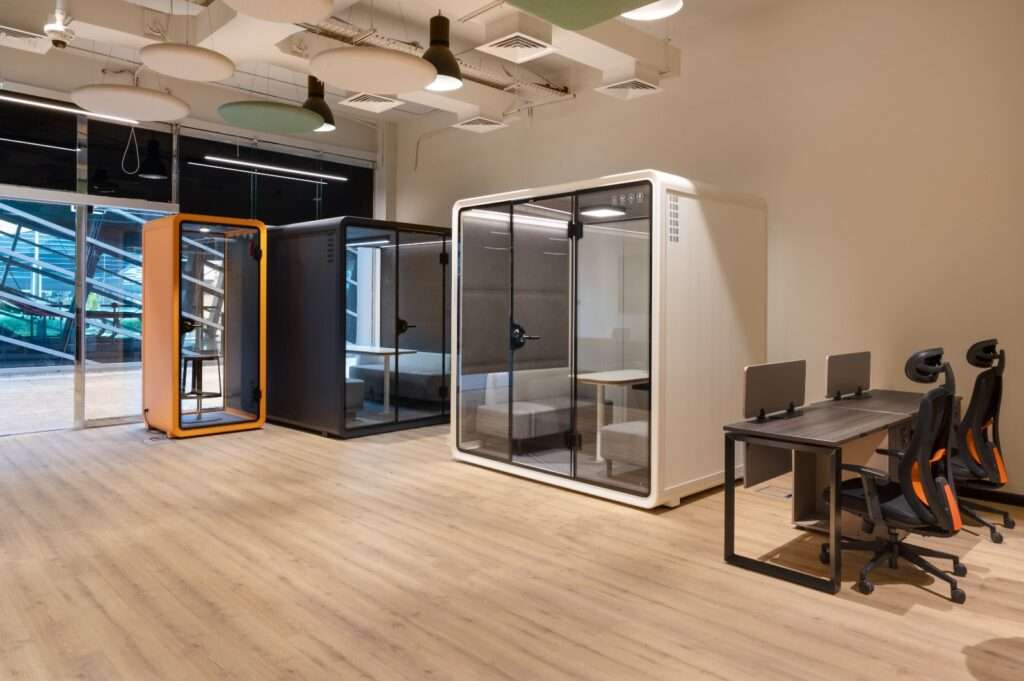
Contemporary work environments are created with aesthetics and flexibility in mind. Open ceilings, open office stations, and open meeting areas with glass walls are all common now. The problem is that noise knows no borders when it comes to sight. An aesthetically pleasing environment that is also noisy becomes very tiring very quickly. Businesses are no longer wondering how to minimize noise in any way possible. The question has changed to how they can control noise without damaging the language of design that it has taken them so long to develop. The approach to acoustic design has shifted from being purely technical to being an integral element of workspace design.
Silence as a Design Problem
Soundproof pods began as a functional solution in the market. Initially, the products served their purpose; however, they looked like something taken from a factory floor setting. Such an appearance qualifies as unacceptable in a modern office environment, where all features are required to justify their aesthetic presence.
In contemporary settings, soundproof pods are considered architectural features. They fit well into open floor designs, creating quiet areas for concentrated work, private calls, as well as small meetings, without requiring any rigid construction. It’s important to note that soundproof pods’ usefulness today does not lie in their sound-blocking abilities, but in their seamless fit into the environment.
We’ve found that what teams want is pods that feel like they are part of the overall design, not tacked on. If the pod’s design has clean lines, nice materials, and a scale that matches the surrounding furniture, it will get used. If it doesn’t, it’s an expensive storage unit.
The benefit is the flexibility. The pods can then move or be adjusted depending on the type of work that is being done. This is now what the “final” office needs, in a world where no one has any idea what the final office is going to look like.
Elements rather than noise buffers
What makes office pods current and especially relevant today is because of what has come to be known as the “hybrid mode” with regard to the “new office.” The office is no longer a space for full capacity use, five days per week. What is needed is a space for collaboration and focus. The pods can offer this without creating a fixed layout.
From a design point of view, consistency is the advantage offered by pods. For floor-sharing teams, pods allow for a balanced and standard acoustics performance without sacrificing the design flexibility offered by different finishes and color options.
Acoustic Panels, which are also aesthetic.
Acoustic panels have evolved significantly from being relegated to behind fabric and corner placement. In offices nowadays, there’s an increasing trend to feature acoustic panels as design statements. We’ve observed that some of the most successful projects incorporate panels as a nod to the visual rhythm of a room. Ceiling clouds, wall features, and even free-standing pieces assist with reverberation while adding visual interest through texture and dimension. Done correctly, panels can enhance a room without competing with it.
As to why that’s important in today’s scenario, the explanation is simple. Open office environments tend to be far noisier than many people give them credit for. Conversations echo, typing adds up, and video conferences spill over. Panels take that problem head-on by dealing with how sound functions within that context, rather than simply how it propagates.
Design-led panels enable brands to also express identity. Color, pattern, and placement enable alignment with the visual language of the company while also being Mazda-inspired. Workers do not necessarily notice the panels, but they do feel them.
Acoustic design at Sonichive
Our design integrates soundproof pods, office pods, and acoustical panels in a seamless rather than a fragmented way. We consider sight lines and flow as well as acoustical requirements. We intend that the solutions work well for functionality as well as design. But we also rely on “real-world” data and studies on how noise impacts focus, stress, and collaboration. But let’s be clear: experience is every bit as valuable as research. We know what works, what gets overlooked, and what is essential.
Long-term benefit
Our clients have already experimented with “quick-fixes” that have not gone the distance. A few panels were fine for the room, but nothing for the floor, they say. A pod resolved the phone problem, but then there’s the visual clutter. Our solution incorporates the best aspects of each. Through our approach to acoustics as a design layer instead of a technical feature, we assist companies in creating spaces with a long shelf life. This means the environment will continue to work for the growing and evolving workforce instead of on them.
By partnering with Sonichive, you’ll be working with an ally in your pursuit to recognize that sound, space, and design aren’t separate entities but rather an intricate web that is intertwined with each other. Peering into the future, that quiet design may have. The future office won’t be mute, and it shouldn’t be. Collaboration, discussion, and excitement are what make the workplace valuable. The key is to transform the noise into something that facilitates work and does not hinder it.
Now, acoustic design that not only complements but also enhances office design is no longer an ‘add-on.’ In addition, it has now become an inherent characteristic of good-performing and also good-looking spaces. Going forward, it’s expected that the best-performing office spaces would be those where sound has also been ‘designed.’ It is there that we see the industry headed, and this is also where Sonichive has continued to concentrate its skills.