
The office is no longer a place of work. In the year 2026, the office is where culture is created, collisions of ideas occur, and concentration is maintained. Some smart companies have already accepted that there is one true thing, and that a workspace that does not adapt to the way that people actually work is nothing more than an expensive empty space, or maybe just a hole.
This revolution begins with contemporary office design and extends well beyond. It encompasses acoustics and hybrid design, along with specific solutions for workers to dictate how and where they work.
Office design is no longer an issue.
Modern office design is no longer an issue of trends, and instead, an issue of intent. Organizations are shifting focus from rigid office layouts to flexible settings that are able to adapt to their groups. International studies on workplace environment have found that employees are more productive in an office that provides diversity. These are areas for collaboration, areas for concentration, and areas that facilitate informal interaction.
The reason this approach is effective is because of its flexibility. The use of modular furniture, moveable partitions, and flexible rooms gives the office the ability to change easily and without needing renovations. Lighting, relaxation spaces, and biophilic design are now requirements and not just preferences. All of these will have an effect on how long those individuals will remain engaged, how often they come to the office, and how connected they feel to the organization.
At Sonichive, we design with user behavior in mind. Every space-planning move informs how teams interact, meet, and focus. An effective office space should be obvious, not cool for the first five minutes, and depleted by noon.
Noise is also one of the sneaky major hindrances to productivity. Excess noise has been shown by several studies conducted. The effect of high noise is shown by several workplace studies, whereby high stress, reduced focus, along high errors have been caused by too much noise. Sound is considered an afterthought.
“Acoustic office solutions revolutionize this experience, with acoustic panels that absorb sound, acoustic ceilings, acoustic furniture, and sound zoning. The dynamics of sound distribution in an environment can be controlled. A well-designed acoustic environment doesn’t make an office sound-free; rather, an acoustic environment makes an office functional.”
The largest benefit is felt when a plan for acoustic conditions is implemented from a rather early stage. Based on sound paths and behaviors, we get environments where one would not need to wear headphones to think. With improved acoustics, fewer interruptions take place, and a marked boost is felt in energy levels.
The hybrid workspace setup is no longer an experiment but the new normal. “The question is no longer whether hybrid works, but whether the office enables hybrid well.” This is according to David Leonardi, an associate professor at the University of California, Los Angeles’ Anderson School of Management. He added that the key to an effective hybrid workplace setup “is to understand that not all people come.
Days for collaboration and days for focus. This is true for people and true for office space. Forward-thinking firms are planning spaces that will give people a reason to come there, to additional rooms for project battles, quiet areas for focused individual efforts, and technology that will ensure that remote and office-based people both feel included in teamwork sessions.
Booking systems, flexible seating, and proper zoning fix frictions and reduce uncertainty. Workers understand what to expect when they go to work, while managers have insights into workspace usage. When a hybrid design goes right, it leads to having the office as a destination rather than a duty.
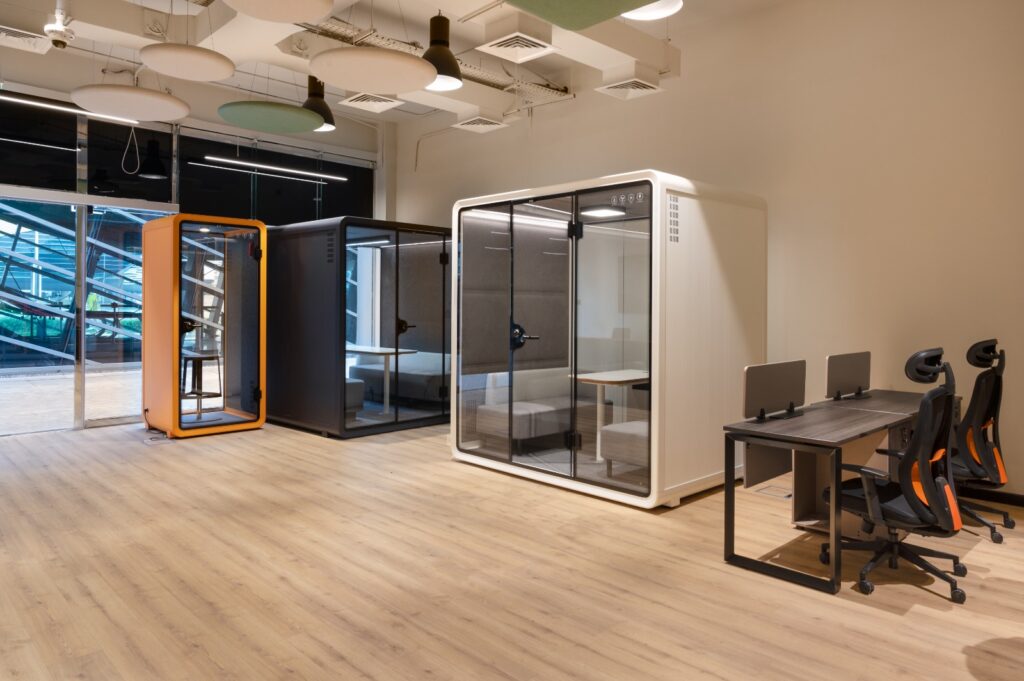
One of the ways through which the effects of noise and concurrent demands in office spaces are countered is through office pod benefits. There are several advantages offered by office pods. An office pod is immediately available as a place providing privacy while making calls or working.
They are most useful in an open plan office where it may be a challenge to locate a quiet spot. These pods allow a balance of an open office space and private space for maximizing staff comfort. They are useful in enhancing space utilization by alleviating pressure from meeting rooms.
At Sonichive, we place our pods in a non-random way. It is essential to note that positioning, audio facilities, ventilation, and access to the booking system also matter. When well done, the pods end up being one of the key facilities in the office that is most used.
Why businesses choose Sonichive
“What sets Sonichive apart is our approach. We don’t design offices on assumptions. We understand how people work, how sound behaves, and how spaces are used. Our process is made possible by research, technical know-how, and observations.”
Rather, we concentrate on the effectiveness of the process: improved focus, streamlined collaboration, and spaces that will adapt to growing teams over time. Our designs and solutions are scalable and quantifiable.
Why This Approach is Relevant for 2026 and Beyond
“The workplaces that succeed in 2026 are those that are designed with clarity in mind. They honor focus, accommodate flexibility, and are robust in change. It’s not just an investment in office design, office acoustics, office hybrids, and office pods; it’s how companies safeguard their productivity and protect their talent,” Miller explained. By choosing Sonichive, one is choosing to partner with someone who understands the role of the workplace in influencing behavior. We create spaces people would like to occupy, spaces for effective work, and offices designed for what’s next. If you want an organization operating at the level of its people, this is where it begins.