
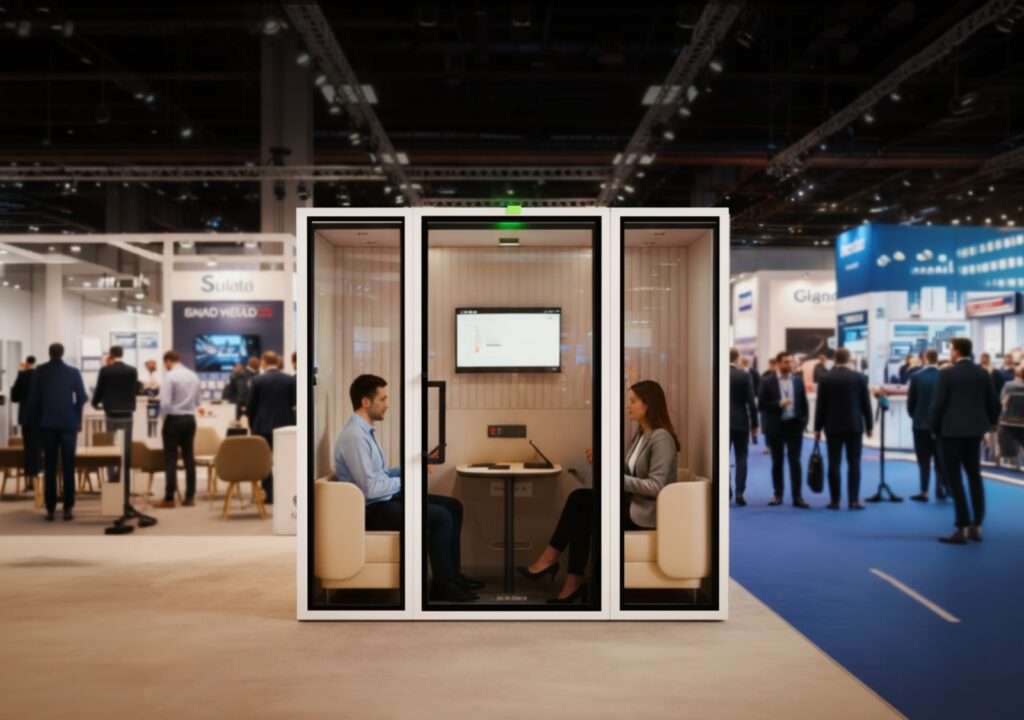
What we’re witnessing in 2026 is quite simple: people are back in the office, but they also expect the same level of focus and flexibility they enjoyed at home. This is now clashing with the reality of shared workspaces, endless calls, and overlapping conversations. Noise is no longer a nuisance, and leaders are now understanding that productivity is less about real estate and more about control.
The Best Noise Solutions for Shared Workspaces Today
When clients ask us what the best noise solutions for shared workspaces are, really, what they are asking for is not theory. They are asking for something that will work without having to rebuild the whole office. White noise machines were a good solution for a time, and the noise-canceling headphones became the norm, but these are just band-aids for a larger issue. They are a personal solution to a communal problem. They don’t solve the problem of noise; they just hide the discomfort.
The better solution is architectural but also adaptable. Rather than having to rebuild the whole floor, progressive companies are implementing acoustic zones. These are enclosed pods that can be placed throughout open floor plans to allow teams to seamlessly transition from collaboration to focus.
Studies have always shown that too much noise in the office affects cognitive function and stress levels. This is what we notice in our conversations with clients. When sound is managed, meetings become clearer. Creativity becomes better. People linger in the office because it becomes manageable. The trick is not just about sound levels: it’s about sound behavior, containing it, absorbing it, and stopping it from spreading across the room. That’s where acoustic pods have been useful.
Soundproof Pods That Actually Perform
There is a difference between a phone booth and an acoustic design. Soundproof pods for office spaces have come a long way. In 2026, they are not simple booths. They are fully functional workspaces. The latest pods are designed with multi-layer acoustic insulation, ventilation that does not affect silence, lighting, and ergonomically designed interiors. They provide a controlled micro-environment within a busy macro-environment.
Practically speaking, this addresses three issues.
First, private conversations and virtual meetings are always taking place. The hybrid work model means video conferencing is now a regular part of office life. Without soundproofed areas, open offices become echo chambers.
Second, when you have sensitive conversations, you need privacy. HR discussions, leadership team meetings, and financial planning sessions. Glass meeting rooms are very attractive, but they’re not very good at soundproofing.
Third, when you do deep work, you need separation. Some activities just require your undivided attention. Pods offer that without separating workers from the overall team culture.
The use of soundproof pods in office spaces is not a trend. It’s a reaction to the productivity gap that can be measured. Companies have come to understand that flexible acoustic infrastructure gives them the agility they need without having to make structural changes.
Why We Designed Sonichive the Way We Did
At Sonichive, we didn’t design acoustic pods as furniture. We designed them as performance solutions. What we learned from our experience in the corporate world is this: companies don’t just need quiet rooms. They need flexible, design-driven solutions that blend seamlessly into high-end workplaces. This is why our acoustic pods are designed as high-performance home pods and office pods that also serve as architectural design elements.
We emphasize acoustic integrity. Materials, sealing, structural design, and airflow systems are all designed to provide sound control while not compromising comfort. A silent pod that is uncomfortable is a failure. A pod that looks great but does not contain sound is a failure. We strike a balance between the two. From our website and client work, it is apparent that today’s offices demand more than sound isolation. They demand flexibility. Our modular design enables companies to expand, relocate, and reconfigure without much hassle.
Why This Approach Works in 2026
The reason acoustic pods have become so critical is quite simple. Today, offices are multi-use spaces. In one hour, an employee could work with a team, join an international video conference, analyze a complex proposal, and have a one-on-one meeting. It is not feasible to expect that one open floor plan can accommodate all these activities equally effectively.
Pods bring choice to the workplace.
Rather than rearranging the whole floor plan whenever a change in needs arises, organizations create sound-controlled areas. This method is economical, scalable, and easily deployable. It honors the existing architecture while improving functionality. From a management point of view, the ROI is quantifiable. There are fewer distractions. Calls are clearer. Meetings are more efficient. Employee satisfaction ratings are stronger. Retention increases when employees feel that their space is conducive to their work style.