
There’s that moment, which most of us know all too well, one where a loud conversation across the room completely shatters your train of thought. Your brilliant idea suddenly evaporates, and you are left staring at your screen and wondering why the office sounds like a café at lunchtime. As workplaces become more open, collaborative, and fast-paced, noise has emerged as one of the biggest productivity killers. We have seen how fast it chips away at focus, mood, and even company culture.
We’ve spent years observing how teams actually work, how they move around a space, and what kind of interruptions hit them the hardest. And most importantly, we’ve learned that you don’t need major construction to quiet an office. With the right quick-fix solutions, yes, the kind that don’t involve drills, dust, or downtime-you can transform the entire soundscape of a workspace.
Quick-Fix Solutions That Actually Work
Acoustic panels have become one of the most popular upgrades, simply because they deliver real results without asking you to redesign your entire office. We’ve watched companies install them on walls, ceilings, and even as decorative partitions, instantly softening echoes and lowering the overall noise floor.
The reason they work is actually quite simple: they absorb the sound instead of letting it bounce around. Think of giving your office walls some much-needed “softness.” Research into interior acoustics shows that even a moderate increase in absorptive materials can cut perceived loudness by as much as 50 percent. That’s the difference between “I can’t hear myself think” and “finally. silence.”
And because panels now come in aesthetic-friendly designs-geometric shapes, fabric prints, even art-you’re not trading quiet for style. It’s one of the few office upgrades that checks both boxes effortlessly.
That Quiet the Ground Beneath You
Rugs are the unsung heroes when it comes to fighting noise. Hard floors love to amplify sound: heels clicking, chairs dragging, footsteps echoing. When we introduce rugs-especially in high-traffic areas difference is immediate.
They absorb impact noise, soften movement, and add visual warmth all at the same time. Even larger spaces can employ the use of layered or overscaled rugs to create silent “zones” around meeting tables or seating clusters. It’s a small change, but like any good supporting character, it plays a bigger role than it gets credit for.
That Bring Peace and Oxygen
Plants don’t just look good. They serve to quiet a space far more than most people might think. Dense leaves and textured surfaces scatter sound waves, reducing reverberation naturally.
We’ve seen offices create plant walls, group tall potted trees near noisy areas, and even use greenery as soft partitions between departments. According to the Journal of Environmental Psychology, plants also improve concentration and reduce stress-which makes them a rare win for both aesthetics and wellness. When your office looks like it breathes, your team does too.
Windows, Rooms, and Everything in Between
Curtains can do much more than block sunlight today; heavy fabric will help dampen the noise that comes from outside and inside the building. We often recommend thick, textured materials in meeting rooms, video-call spaces, or large glass partitions-anywhere sound loves to ricochet. When you layer curtains on an already smart layout, you soften the room’s acoustics in a manner that feels natural, not engineered.
They also give flexibility: Draw them for quiet, slide them away for open collaboration. It’s a functional upgrade that adapts to how your team works, not the other way around.
Double as Design
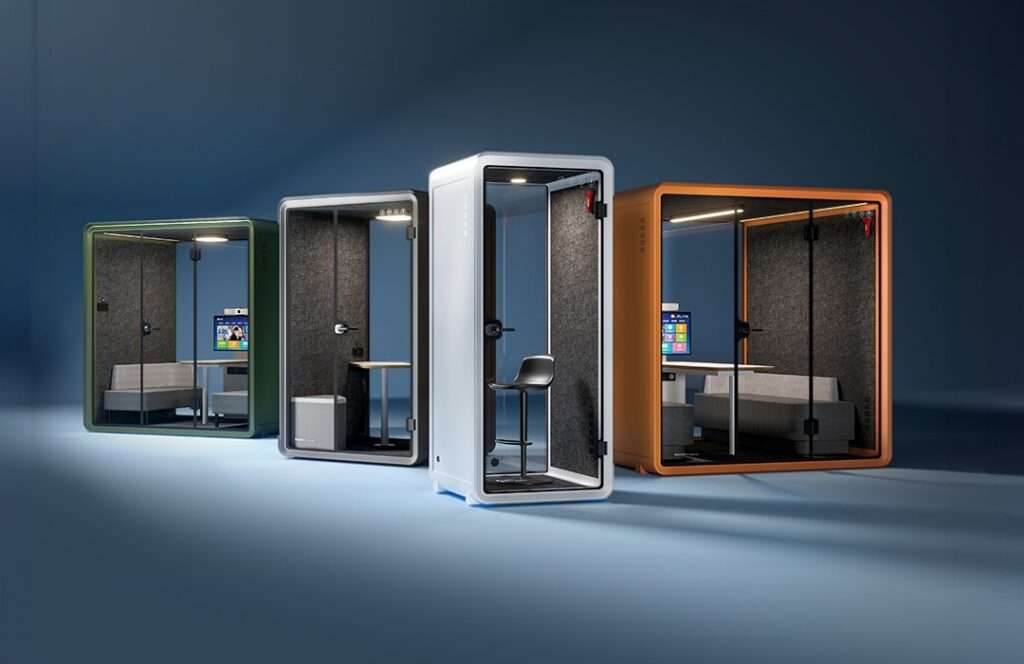
Furniture has undergone a quiet revolution, literally. Modern office pieces are designed with built-in sound-absorbing furniture with cushioned booths, high-backed sofas, acoustic work pods, and even cabinets that soften sound instead of reflecting it.
These pieces create micro-environments that enable people to focus, talk, brainstorm, and take calls without feeling as though they might be broadcasting to the entire floor. In most workplaces, the simple rearrangement or addition of a few such strategically selected furniture elements creates pockets of calm that change how the whole team functions, and yes, they look great. Quiet doesn’t have to be boring.
Why These Solutions Have Become So Popular
The demand for non-invasive sound control is skyrocketing because companies want results without downtime. Nobody wants a week of drilling, or even worse, the chaos of temporary closures. Leaders want improvements that can be installed overnight or over a weekend, and they want comfort without disruption for their teams.
These solutions tick all those boxes. They’re fast. They’re stylish. They can be scaled up or down depending on team size. And most importantly, they work. They make an office feel intentional again.
Why We Recommend Sonichive for the Complete Experience
At Sonihive, we’ve been obsessed with what makes a workspace feel balanced. For us, sound is not just another checkbox; it’s the heartbeat of productivity. We have spent years designing environments that let teams move freely, collaborate naturally, and protect their focus. We don’t believe in guesswork. We analyze how your team uses each corner of your office, where interruptions spike, what kind of noise patterns develop throughout the day, and which zones need the most support. Then, we design a noise-control layer to fit your space, like it was built with acoustics in mind from day one. From quick fixes to immersive sound pods, we’re here to help your office feel calm, focused, and intelligently designed–without tearing down a single wall.